
Garden Valley Citizens Committee
Proposed Levy Position Paper
Question
Is the levy, for the stated purpose of maintaining the stipend for volunteers, appropriate at this
time?
The Garden Valley Citizens Committee position is: Decisively NO!
Summary
Seeking a levy for the purpose of providing stipends is not currently advisable. There are many planning issues remaining that have not been addressed and will be a financial burden on the community in the future.
The reliance of out-of-area recruits creates an unstable operational model while masking critical service gaps that need to be properly addressed. Since the Boise Recruits don’t live in Garden Valley, they are not available to respond to “All Calls” when they are not present for their on-duty shift. The critical need is within the first few minutes and not an hour later.
Based on other discussions, requiring a volunteer to meet the requirements for both an EMT and a Firefighter has exacerbated low recruitment numbers, which could be improved with a less stringent policy. The lack of consideration in implementing NFPA 1010 Chapter 5 limits the fire department recruitment efforts and does not take advantage of the local community.
The fire department should engage the community to define the level of service residents both expect and are willing to fund, rather than basing its plan solely on NFPA standards designed for high-intensity incidents that occur only once or twice a year.
The department must prioritize the community’s need for reliable ambulance service by clearly defining its role and making a definitive, long-term commitment to maintaining that service essential to the community.
Our critique of this program is in no way a reflection of the dedication and heart that the employees and volunteers put into our community daily. We owe it to our volunteers to give them the training and equipment they need to operate safely and a department that is financially healthy for years to come
Recommendations
-
- Reject the proposed levy.
- Maintain the On Call sign-up program, indicating availability without the shift stipend.
- Eliminate the current Paid Per Shift program.
- Utilize the Paid Per Call program and training stipends.
- Implement NFPA 1010 Chapter 5 to recruit volunteers willing to serve in supporting
roles. - Increase the number of volunteer positions to 40.
- Reconsider the requirement that a volunteer must be trained as both an EMT and a
Firefighter. - Develop a Volunteer Recruitment Program that draws from the local community.
- Openly accept and develop local community volunteers with specialized skills who will
serve and support the overall mission of the department. - Update the Strategic Plan.
- Develop a realistic Equipment Replacement Program.
- Fire Chief to obtain an EMT certificate.
- Organize and promote community involvement in determining an appropriate long-term
plan to maintain and enhance medical transportation.
Origin
The proposed levy was initiated by the Garden Valley Firefighters Association, not by the Fire Department Administration. The Firefighters Association has historically been involved in fundraising to support the department programs and has never been involved in promoting a tax levy that will provide financial gain directly to the members.
Process
The proposed levy was brought forward by the Association to one or both fire commissioners outside of a public meeting. Prior to the public gaining knowledge of the proposed levy; without a discussion of the proposed levy at an open meeting and without any opportunity for public input regarding the need for and purpose of a levy, the proposal was forwarded to the attorney for ballot language preparation. It was stated at the fire commissioner’s meeting held on February 10, 2026, that the two commissioners present had not discussed the levy prior to this meeting. This raises the following questions: Who authorized the attorney to prepare the ballot language? Did a board member or the Fire Chief unilaterally authorize the attorney to move forward with the levy ballot language prior to any board discussions or public input?
Stated Purpose
This levy was introduced as “funding the On Call system,” while the On Call system was described as a communications system.
The communications system aspect of this program is the daily sign-up of volunteers to provide for a committed roster of a specified number of volunteer responders on any given day, visible to all members through the CODA program. The fact that a volunteer does not sign up for a shift does not indicate that the volunteer would not be available to respond to an emergency, except in the case of the Boise Recruits, who would not be available. In fact, the emergency delivery system is already dependent on the “All Call” for structure fires.
There are benefits to utilizing an On Call system as opposed to relying on a general “All Call” system for every emergency, but the utilization of the On Call system is not dependent on the payment of stipends. The system could still be utilized and provide all the stated benefits without any stipend being paid per shift. These are two separate issues, one of which is where money is being used as a motivator to get volunteers to sign up for shifts. Returning to the Paid Per Call model with training stipends would meet the desired goal of offsetting any costs incurred by a volunteer and greatly reduce the overall costs. The Garden Valley Citizens Committee has a concern that if this levy, as written, is approved and restricted to stipends, there will be no clear exit strategy from the Pay Per Shift program, and the next step would be transitioning to a fully paid, full-time model, likely requiring an additional levy of at least $1 million.
As stipends increase over time, they are likely to exceed 20% of a firefighter’s compensation. Under Federal FLSA law, these payments will no longer qualify as stipends, triggering minimum wage requirements and further increasing the need for additional levy funding; reinforcing that this program, funded by this levy, will have no clear exit ramp.
For clarification, the On Call program does not provide firefighters in the firehouse 24 hours a day, 365 days a year. Volunteer firefighters respond to the firehouse to staff equipment when notified of an emergency. On-Duty means that a volunteer has committed to making themselves available to respond to calls for a 12-hour shift, not that they are at the firehouse.
Current Financial Reality
The Garden Valley Citizens Committee is concerned that the department’s current financial realities and needs were not fully considered before advancing the Firefighters Association’s proposed levy to fund stipends.
On January 1, 2023, the funds designated for Maintenance and Operations (M&O) totaled $414,655.83. By January 1, 2026, the available funds for M&O had declined to $106,461.18. This represents a decrease of $308,194.65 over a three-year period. These funds represented “Reserve Funds” held for unexpected expenses, as well as Capital Funds for
equipment purchases.
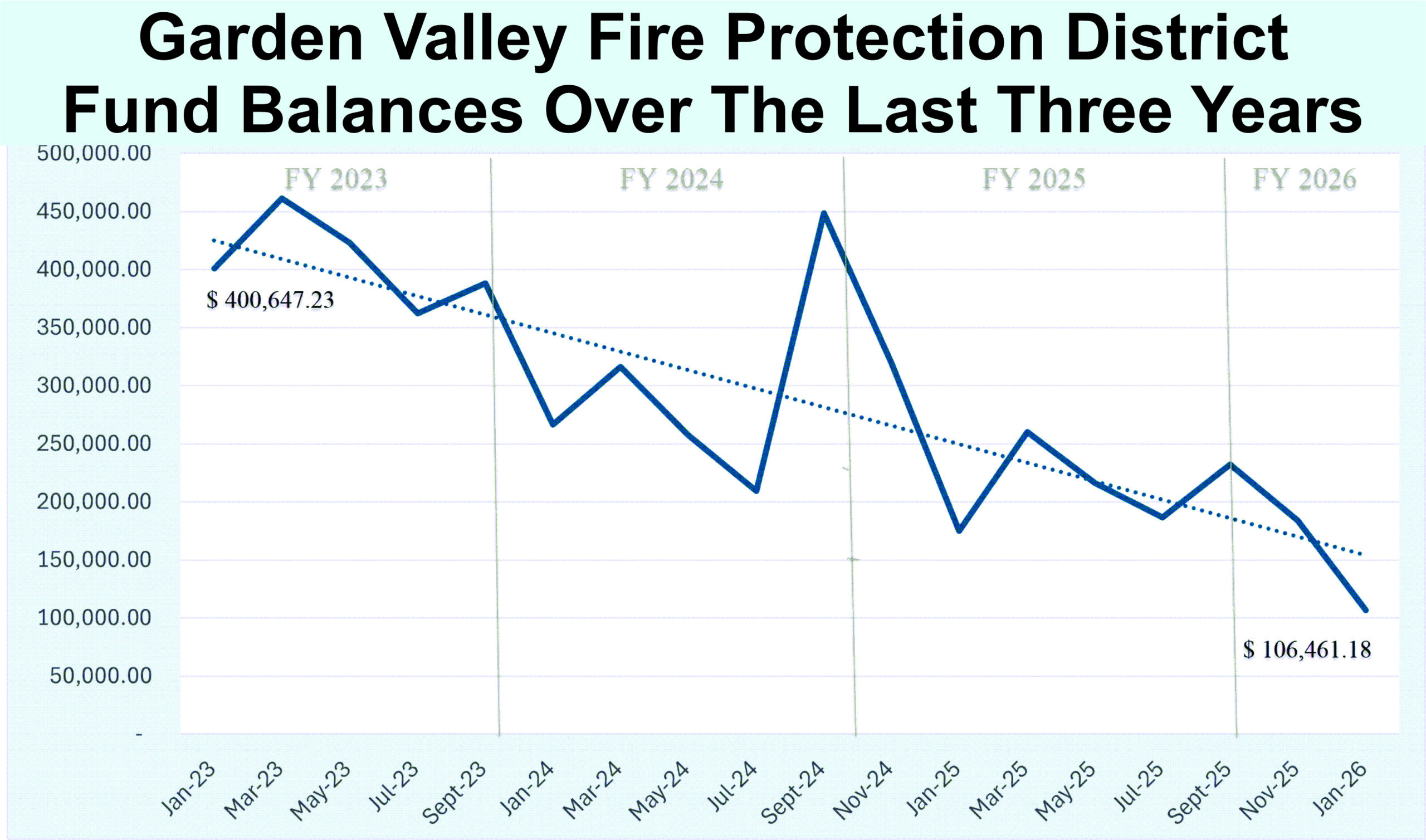
Funding per-shift stipends for the Paid On Call program had the greatest impact on the decline in available funds. Chief Cleaveland is the only remaining member of the original group of four who implemented the Paid On Call program. Although it was introduced as a test program approved by the fire commissioners, that designation did not diminish the responsibility of the Fire Chief to monitor and manage its financial impact. As reserves declined, there was a duty to recognize the trend and take corrective action. The Fire Chief, responsible for overseeing the budget, had an obligation to inform the commissioners that the shift payments for the Paid On Call model were rapidly depleting reserve funds and to recommend pausing the program and returning to a Paid Per Call model or another fiscally responsible alternative.
None of these occurred.
Strategic Planning
What strategic plan has been developed to define the department’s anticipated future
needs and its projected course?
That question was asked of the fire administration through a public records request, specifically for the Strategic Plans referenced in the minutes of the April 11, 2023, Fire Commissioner meeting.
The following document was provided:
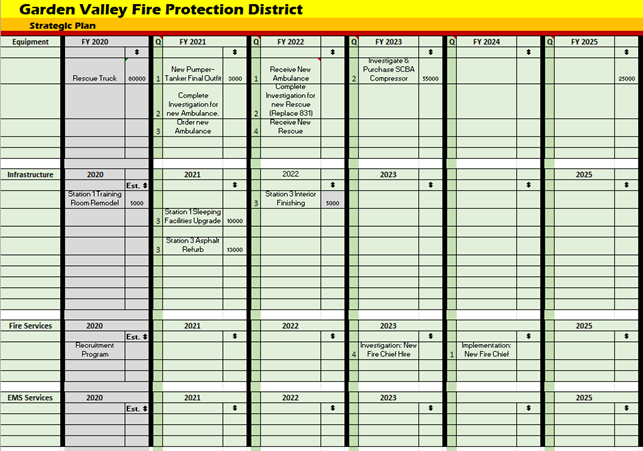
The lack of any entries in 2024 and 2025 raised a concern, and a subsequent request indicating the document provided did not seem to be the correct one. Chief Cleaveland responded that the document did not exist.
The acknowledgment by the fire administration that there was no written strategic plan is of great concern to the committee and was amplified when a similar request was made for the equipment plan.
Equipment Replacement Plan
What is the equipment replacement plan and the impact on future budgets?
A Public Records Request was submitted for the document referenced in the minutes of the March 21, 2023, Fire Commissioner’s meeting. Chief Cleaveland provided the same response as he did for the Strategic Plan; the document did not exist.
Another document provided in response to the Public Records Request for the Strategic Plan and Equipment Replacement plan was the Current Inventory and Replacement Value,
which is provided below:
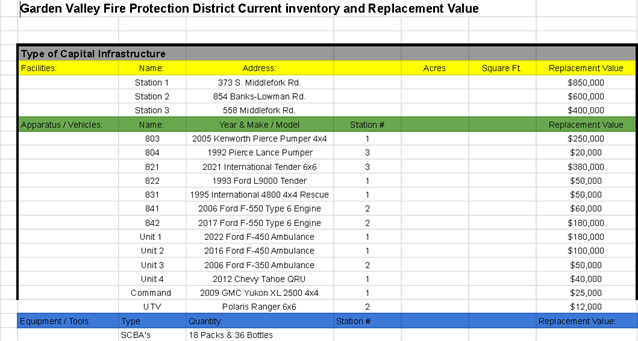
The document does not provide a year when the replacement is anticipated, and the replacement costs are not in line with current equipment costs.
What is documented in the minutes is that Engine 804 does not pass the pump test due to an overheating issue and has been converted to a Rescue Unit.
Another apparatus experiencing issues is Unit 822, the 1993 Ford L9000 Water Tender. This apparatus is unable to pump water uphill. This was documented in the fire report prepared after the residential structure fire on Banks-Lowman Rd, which occurred on April 5, 2025.
Unit 821, a 2021 International Water Tender, is equipped with a pump capable of supplying handlines, but has a primary mission of water supply and cannot meet the primary objective if committed to supporting handlines on the fireground. Utilizing this equipment as an Engine
will require the purchase of another water tender.
Unit 831, a rescue unit, was documented in the September 12, 2023, minutes as being sold, but remained on the current inventory list in 2025.
The department is currently without a reserve engine capable of passing the pump test.
The noted equipment discrepancies indicate a significant reduction in response capabilities and operational readiness.
Lacking any current documents prepared by the fire department, a review of the 2023 Boise County Community Wildfire Protection Plan provides information regarding the timeframe for equipment replacement but does not provide an estimated associated cost.
The following replacement schedule represents the anticipated needs listed in that document.
2023 Replace Rescue 831 Action Taken: Sold – Converted Engine 804 as a Rescue Unit
2023 Replace Command Vehicle 851 Action Taken: Configured the military vehicle as the Fire Chief’s Command Vehicle with an approved cost of $43,000. This lasted less than a year and the department retained Command Vehicle 851.
2024 Replace Engine 804 Action Taken: Not Replaced – Converted to Rescue Unit
2024 Replace Medic 3
2025 Ranger UTV with tracks
2026 Replace Type 6 Engine 841
2027 Replace Unit 4 with Quick Response Unit
2027 Cataraft
2028 Replace Water Tender 822
2030 Replace Engine 803
2030 Replace Medic 2
2035 Replace Medic 1
2039 Replace Type 6 Engine 842
2045 Replace Water Tender 821
Based on the above information, the fire department has an immediate need for an engine, had scheduled to replace an ambulance in 2024, has scheduled to replace a Type 6 Engine (Wildland) this year, and between 2028 and 2030 has scheduled to replace an engine, water tender and another ambulance.
Currently available funds are insufficient to facilitate these purchases. Existing lease obligations remain in place, with the ambulance scheduled to be paid off in 2027 ($26,202 annually) and the water tender in 2029 ($36,821 annually).
Implications of Lack of Planning
Without a tangible Strategic Plan and an Equipment Replacement Plan to review, the department is operating with a short-term focus and in a near-crisis mode of management. Without a clear understanding of the department’s future needs, it is difficult to conclude that the proposed levy for stipends represents the highest and best use of taxpayer funds.
These future equipment needs include fire engine, water tender, Type 6 engine, rescue unit, ambulances, Self Contained Breathing Apparatus (SCBA) and turnout gear.
The Boise Recruits
There have been concerns raised that the “Boise Recruits” would no longer participate if this proposed levy does not pass. The statement made at the March 13, 2026 information meeting “Without the stipend, we are asking volunteers to dedicate their own money and time to come up and provide this service” suggests that one purpose of the proposed levy is to support and maintain reliance on the Boise-based recruits rather than drawing from the local community.
It has been stated that there are approximately 13 Boise recruits. This is more than 43% of the total number of volunteers. The fire department stresses the need for personnel to be on scene of a structure fire to meet the tasks required but has discounted that the reliance on the Boise recruits is depriving the community of an adequate local response to a fire. The Boise Recruits are not going to respond from Boise to a structure fire. Consideration should be given to whether continued use of department resources to support the Boise-based recruits remains appropriate.
Stipend
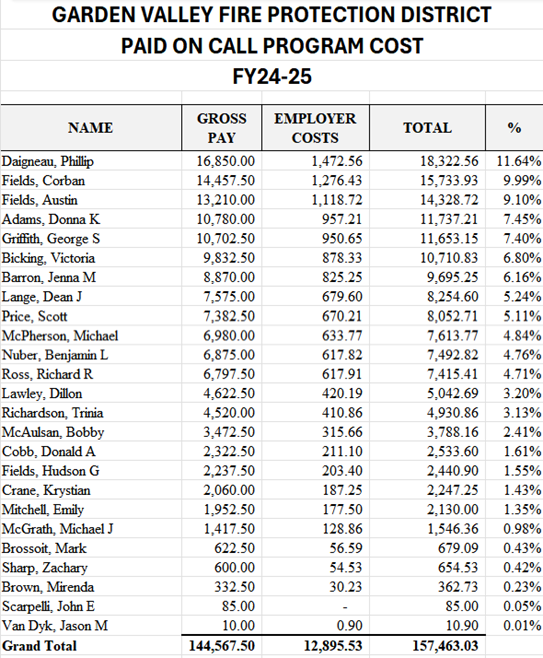
What has been promoted as a nominal stipend to cover personal expenses for the volunteers has provided a second income to some that exceed any personal nominal expenses. Twelve of the 25 participants (48%) in the Paid On Call program received 83% of the total stipends; with individual payments ranging from over $6,700 to $16,850.
In addition, the proposed levy amount of $186,150 does not include the employer costs of approximately 10%.
The following is a table illustrating the program costs:
Levy Ballot Language
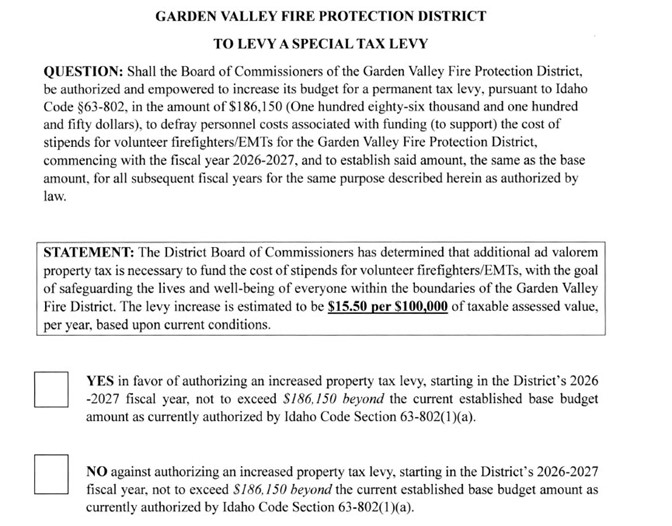
For a complete list of records requests and video or audio/recordings of meetings, please visit our website. https://gvidcc.org/